Online Interview with Apollo 20 Astronaut William Rutledge
References:
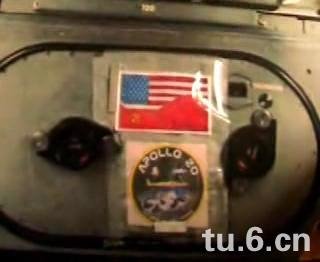
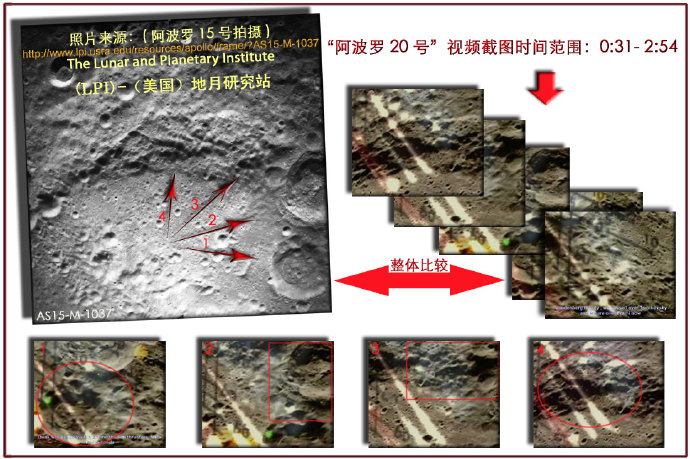
Presumed photo taken by
Apollo 20 crew (August 1976′).
Source:
picture from a video added by “retiredafb” on YouTube
(year 2007)
Official NASA photo
(detail of AS15-P-9625),
Apollo 15, 1971.
Courtesy NASA/LPI
The Space Shuttle Launch Sites: Vandenberg Air Force Base
and
Kennedy Space Center.
Courtesy NASA
Titan Launch from the
Vandenberg Air Force Base,
in California.
U.S. Air Force Photo
Courtesy NASA
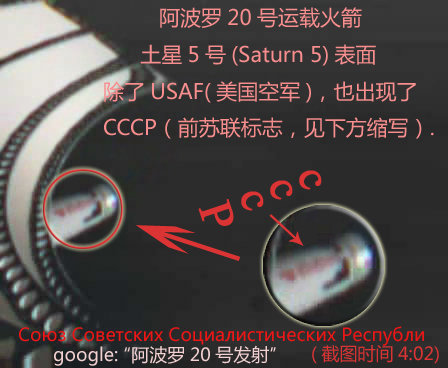
Frame from the footage
<<APOLLO 20 Legacy liftoff
of Apollo 20 saturne 5>>,
added on YouTube
by “retiredafb” on April 9, 2007.
Another detail of the mysterious
and huge cigar-shaped object:
zoom from AS15-M-1579
High Resolution Image,
taken on Apollo 15 (1971);
camera altitude: 116 km;
revolution: 38;
Sun Elevation: 24°;
Lens Focal Length: 3 inch
Courtesy NASA/LPI
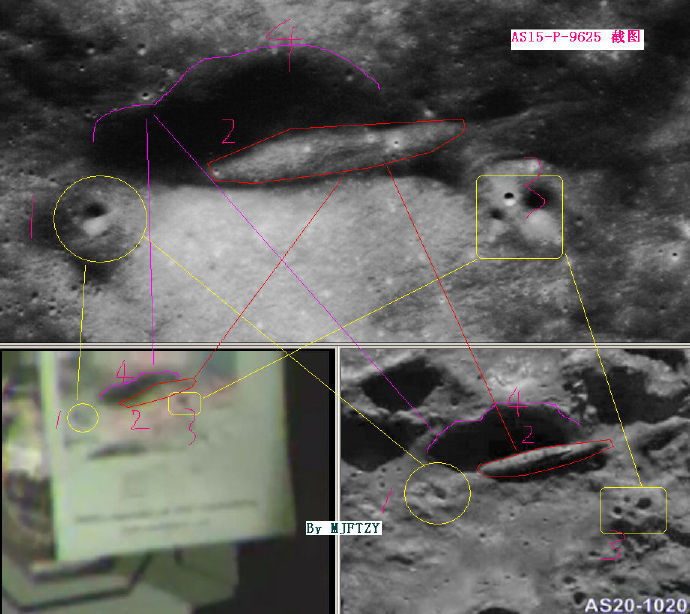
Analysis of the detail of
AS15-P-9625 photo,
(Apollo 15, 1971),
using the
Gimp Software
– by L. Scantamburlo –
Frames from the
?Apollo 20 flyover?
on a presumed alien spaceship,
on the backside of the Moon – source: footage added on YouTube by “retiredadfb” and taken by
the LM-15 (Phoenix) crew
before the descent.
OFFICIAL PHOTOS
BY NASA
(APOLLO PROGRAM)
– Far side of the Moon –
Detail from AS15-M-1037
Detail from AS15-M-1333
Detail from AS15-M-1579
Detail from AS15-P-9625
Detail from AS15-P-9630
Photos Courtesy NASA/LPI
Preface:
Ever since auagate uploaded the Chinese-annotated Apollo 20 videos, questions and information-mining about Apollo 20 have never stopped. Because so much of the material comes from foreign-language websites, which limited what friends in China could learn, many volunteer translators also appeared, working unpaid to help everyone understand the truth. The Apollo 20 videos originated on YouTube. Afterward, Italian freelance journalist Luca Scantamburlo conducted a written interview with the video uploader—William Rutledge (an Apollo 20 astronaut)—along with extensive information gathering, and published it through his website. Through the Luca URL provided by auagate: http://www.angelismarriti.it/ANGELISMARRITI-ENG/home-ENG.htm you can find information beyond these videos. I also selected one interview with W.R. for translation, hoping everyone can understand how the affair unfolded. Later I found that some of its content is also mentioned in AUAGATE’s videos, so I used those as a reference as well. The English original is here: http://www.angelismarriti.it/ANGELISMARRITI-ENG/REPORTS_ARTICLES/Apollo20-InterviewWithWilliamRutledge.htm
The Full Story of the Apollo 20 Affair <Note by Binghe (AlienRes)>
Apollo 20 was a lunar landing mission originally planned by NASA, but officials later said the launch was canceled for budgetary reasons. Apollo 18 and 19 were also declared canceled; this can be checked on NASA’s official website. But in 2007, multiple videos suddenly appeared on YouTube claiming to be from a secret Apollo 20 mission, including pre-launch preparations, rocket launch, flight, in-cabin checks, lunar orbit, moonwalks, a giant spacecraft, and “human remains.” According to an Italian independent journalist’s investigation, the person who uploaded the videos was William Rutledge, an astronaut on the secret Apollo 20 lunar mission.
Afterward, a netizen called “A Chinese Person” brought the videos into China, translated and organized related materials, and after releasing some of the videos in late 2009, produced the complete annotated versions above. To this day, no one has stepped forward to claim they made these videos. In early 2010, many major Chinese media outlets (Sina, Tencent, Sohu, Xinhua, CCTV) almost simultaneously reported the Apollo 20 affair on the same day. Videos that appeared in 2007 spread widely in China by late 2009, and then months later in early 2010 were suddenly covered collectively by numerous domestic media.
The netizen “A Chinese Person” conducted a rigorous investigation and argumentation regarding the authenticity of these videos, combining earlier Apollo 16 and 17 lunar surface photos, NASA-related materials, instrument patterns, historical background, and more, and set up a Q&A thread on Baidu Tieba addressing many issues raised by the videos. That thread has since been deleted. We know that proving something false requires only one solid piece of evidence, but proving it true requires a great deal of evidence and is difficult. Yet so far, all kinds of signs point to Apollo 20 having actually happened, and that this affair is only one of many events NASA has concealed. Looking back now at the information revealed by Apollo 20, I believe friends who have been following UFOs recently will also find it not hard to understand and accept.
Formal Interview: <Alien Spacecraft on the Moon: Interview with W.R., Apollo 20 Astronaut>
Written Interview with William Rutledge—Apollo 20 Astronaut
Translation: Binghe (AR) Proofreading: Koori
The interview was conducted through my YouTube account——-By Luca Scantamburlo
Update
I have decided here to avoid disclosing the names of those people W.R. mentioned in interview answer 24 who still work for NASA; this is very necessary. Despite the astonishing video imagery and detailed reports he provided, we still look forward to more evidence for this shocking story of his. In fact, as government employees, their names are real in the public domain, but so far they have not been regarded as pioneers who shaped history, and I had never been in contact with W.R. before—but things may change…
Let us see what happens.
L.S
June 30, 2007
In 1976, was a secret U.S.–Soviet cooperative lunar exploration space mission carried out? Is that possible? Why not—if you consider, for example, the existence of federal agencies such as the NRO (National Reconnaissance Office) and the missions of those reconnaissance satellites overhead, “declassified in September 1992” (according to the official website). Then a joint mission prepared to explore an alien craft discovered on the far side of the Moon,
could such a joint mission possibly be true?
W.R. (according to his story, this man, already 76 years old and now living in Rwanda, once worked at Bell Labs and was employed by the U.S. Air Force) is the name of the “whistleblower” who, since April 2007, began revealing information related to Apollo 20 on YouTube and publicly released large amounts of video and photographic material. His YouTube username is “retiredafb.” So far the most astonishing imagery he has released is of an ancient alien spacecraft discovered when Apollo 15 flew over the far side of the Moon.
NASA’s officially announced final crewed lunar landing mission was Apollo 17, carried out in September 1972, while the Apollo 20 mission was canceled as early as January 1970. These images are not the only materials released in recent weeks; W.R. also released video of flying over the alien craft (viewable on YouTube, like the Apollo 20 launch-check video). In addition, many strange objects can also be seen on the far side of the Moon on YouTube. (Photo numbers AS20-1020, AS20-1022, AS20-FWD-7250). Quoting from the file description of these image materials uploaded by W.R.: <“Apollo 20 flew to the Moon on August 16, 1976, destination ‘LSZAK D’ (crater) southwest of Delporte crater on the far side of the Moon. The mission was a U.S.–Soviet collaboration; the commander was W.R., a researcher at Bell Labs; Leona Snyder, a CSP Bell Labs member; and Alexei Leonov, an astronaut from the Apollo–Soyuz mission (one year earlier).”>
In the interview transcript, you will find some contradictions in W.R.’s memory, which is entirely understandable, because for a 76-year-old man, trying to recall the events and historical truths of his life is far from easy. So even when he recalled that during the attack on the parliament building, former Soviet President Yeltsin deployed tanks and troops, placing it in 1995 or 1994 (the actual civil conflict occurred in 1993), I was not surprised. <“In 1994 or 1995, I was invited to the Ural region—I don’t remember clearly; in any case it was a mess. When I passed through Moscow, tanks were firing at the parliament building.” —Interview Q&A No. 8, W.R.>
Later I verified this in an encyclopedia, but before that I could not answer, because I only remembered that it happened in the early 1990s.
On the other hand, W.R. used a great deal of technical terminology and showed me knowledge of geology and chemistry as well as the history of space exploration. For example, in the interview he mentioned a “feldspathoid,” a “mineral composition containing aluminosilicates in which the silica content is too low to form feldspar.” (from the 1995 Third New International Dictionary explanation)
Therefore, I have sufficient reason to believe W.R.’s testimony:
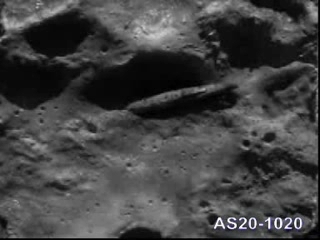
First, on the far side of the Moon there really is (or was?) a strange, enormous object, and its shape is very close to what is shown in the YouTube video: the object I am referring to can be seen in numerous photos from NASA’s Apollo 15 mission. This cigar-shaped object appears to be parked beside a crater, slightly tilted; and the regions visible in the video are very similar to those visible in NASA’s original photos brought back by Apollo 15. The coordinates of this unusual object on the Moon are as follows: latitude 10° S, longitude 117.5° E, southwest of Delporte crater and north of LZSAK. I have verified this on lunar maps: it is on the far side of the Moon.
NASA’s official photos can all be viewed on the website of the LPI (Lunar and Planetary Institute in Houston), a research institution that provides support services to NASA and the planetary research community. Photo links are as follows (AS15-P-9630 and AS15-P-9625—from the Apollo atlas):
http://www.lpi.usra.edu/resources/apollo/frame/?AS15-P-9625
http://www.lpi.usra.edu/resources/apollo/frame/?AS15-P-9630
Furthermore, it is quite telling that all of these links were provided by W.R. (How did he know these panoramic image details?)
And the second reason I believe W.R. is that he has not received any payment for doing these things. The third reason is that the story he told me in the interview contains a large amount of technical and other distinctive viewpoints that are coherent and clear. Today, biographies of famous NASA astronauts are only incomplete. But he kindly answered every question I threw at him without any hesitation, and he also provided many names of Americans and Soviets who may be related to this top-secret space mission. Some of them are still alive; if comments could be obtained from them, that would be very interesting.
The fourth reason is the quality of those videos on YouTube, which is consistent with the camera equipment available in the 1970s and 1980s. I once asked an imagery expert, an Italian friend of mine whose initials are F.D. His analysis of the videos uploaded by W.R. is as follows:
<“i punti luce sovraesposti e la relativa ‘scia’ presentano tutte le caratteristiche dei difetti delle telecamere basate su tubo di tipo VIDICON. La ‘scia’ consiste in una persistenza del segnale video all’interno del tubo. […] Nonostante quest’ultimo sia un sistema di ripresa televisivo obsoleto, oggi la ditta Hamamatsu (www.hamamatsu.com) realizza telecamere VIDICON all’infrarosso”>(Italian)
<“Those overexposed bright spots and related trails all exhibit the characteristics of defects in TV cameras based on VIDICON-type tubes. These ‘trails’ consist of residual video signal persistence inside the tube”[…] Although this is an obsolete television camera system, the Hamamatsu company still produces cameras using infrared VIDICON tubes today>
And in fact, among the various photographic equipment carried on Apollo 17, there was a Westinghouse color camera that could be used in the command module, handheld or mounted on a stand. It is clearly apparent that this equipment is very similar to the camera gear W.R. said was used on Apollo 20, launched in 1976.
(Source: http://www.lpi.usra.edu/expmoon/Apollo17/A17_Photography_cameras.html.)
In any case, the public will be the first judge of this story’s authenticity, and in the not-too-distant future, this story may well become decisive evidence that we are not alone in the universe.
[Preface—To the Reader]
In the following interview with W.R. (now living in Africa), in some places where I was able to make changes, I corrected some spelling errors in W.R.’s answers (for example, I added correct capitalization and apostrophes), but I did not change the syntactic structure of W.R.’s replies. Where I could not understand, I used […].
W.R. told me that he is now old and has some joint problems. And he explained to me that he is always tense when writing. That is why you can find many errors in the YouTube video annotations. In any case, here is a sentence he wrote to begin the Q&A.
<I have not used English since 1990, and switched to Kinyarwanda and French. I type fairly fast, and sometimes in my haste to type the next letter I miss the previous one, or hit a different letter—and that is all true…>
Below, L.S. denotes journalist Luca Scantamburlo; the respondent W.R. denotes William Rutledge
LS: First of all, thank you very much for taking the time to be interviewed; this means a lot to me, and I guess that for people around the world, after you uploaded the astonishing Apollo 20 videos and information on YouTube, they are all very curious about what this is really about. So now let the interview begin. Given the habits of my profession, I will proceed from a skeptical angle. Therefore, I hope you can understand. You will have enough time to answer and explain your reasons.
1. What is your name? How old are you, and are you a U.S. citizen? Sometimes the English you write contains many spelling errors… Have you forgotten the grammar (for example, you wrote “microscope” as “maicroscope”)? Some people online think you do not seem to be a native American (based on your writing)….
WR: No problem; I like responding to skepticism—you cannot imagine the skepticism I have received from people. My name is William Rutledge, not Stanford Rutledge—that is someone else. I was born in Belgium in 1930; I am a U.S. citizen. I know about those errors you mentioned; because of joint problems, I write (type) fairly fast, and I am tense and trembling, as if trying to control flowing water. After 1990 I did not often speak English. I have learned Kinyarwanda and use French, and sometimes German, because Rwanda was once a Belgian colony.
2. LS: Why did you move to Rwanda? How long have you lived here?
WR: A lady brought me to Rwanda; perhaps I had always been looking for someone with whom I could share my life. Personally, I am rather drawn to women born in Africa. (Buzz Aldrin is the same; he was the only astronaut who took a spacewalk after Martin Luther King Jr.’s death [translation pending verification]—and these are little-known stories.) Later, under a new identity, I settled in 1990 on an unnamed street in Kigali (the capital of Rwanda), and stayed in the Nyiamirambo area until 1994, when war forced me to move to the northwest of the country, near the border with the Democratic Republic of the Congo. The Rwandan authorities do not know my past, nor do my friends.
3. LS: Can you tell me something about your life? Where are you from? Where did you study?
W.R.: I have written about this in some of my other answers—Avro, Chance Vought Aircraft. Just consider the U.S. Air Force: they recruited anyone with skills—White, Black, women, every citizen. NASA was different; all astronauts graduated from West Point, except Alan Bean who was an artist, Armstrong who was a philosopher, and Aldrin who was a religious man.
4. LS: How did you become a NASA astronaut in the 1970s?
W.R.: NASA did not hire me—the U.S. Air Force did. My job had been researching foreign technology, only regarding the Soviet Union. Research on the N1 program, the AJAX aircraft project, and the MiG-25 Bat fighter. I had some skills in computer navigation and was a volunteer for MOL-Gemini (Gemini spacecraft) missions. Later I was selected for Apollo 20 because I was one of the few pilots who did not believe in God (that situation changed after 1990)—but that was the standard in 1976. This was not the state a NASA astronaut was supposed to be in (referring to believing in God); whether one believed in God made the difference—that was the whole reason.
5. LS: Can you prove your identity with photos and documents from your NASA training or even earlier from your time working at Bell Labs? Can you send them to me as attachments for publication?
W.R.: Of course, I will put them online, but I will focus my energy on Leonov, to put an end to the debate over this being a hoax.
6. LS: When, and more importantly why, did you decide to reveal information about these top-secret space missions? Is anyone protecting you?
W.R.: Perhaps it was the announcement of “The Wonder of It All,” and 2012 is very near. I also think that starting from September 2007, UFOs will appear more frequently. In Rwanda, many people around me have died; I must spend more time protecting myself. As for protection, please understand that I cannot name those who protect me.
7. LS: After the “Apollo 20” mission, what did you do? And when did you leave the United States?
W.R.: After that, many things happened. At the time I did not realize how the collected materials (possibly referring to mission harvest) would be used. I thought the Space Shuttle was a bad idea. Before retiring, I had worked on the KH-11 program.
8. LS: In your YouTube text, you mentioned the full crew of Apollo 20, including former Soviet cosmonaut Alexei Leonov. I recall he is still alive. Does he know what you are doing online? Before April 2007, had you contacted him? If not, aren’t you worried about what he might do or say?
W.R.: Leonov does not know about this, and I have been unable to contact him; our contact was completely cut off between 1984 and 1982. In 1994 or 1995 I was invited to the Ural region—I don’t remember clearly—but it was a mess; when I passed through Moscow, tanks were firing at the Russian parliament building. I cannot imagine his reaction; if he discovered these videos without any preparation, he might confirm them or leave immediately. If he were warned and prepared, then he could also deny them.
9. LS: A question about the dialogue subtitles in the “spacecraft video”: Did you make them yourself or did someone else? There are many errors (for example, the personal pronoun “I” should be capitalized, not “i” as in the video). So what was the original dialogue? Was it included in the original version of this clip? (Meaning: were the subtitles added later by W.R. or originally present?) Did you encounter encoder problems during conversion?
W.R.: Yes, many problems; the subtitles were done before conversion. For that I had to travel a long way and will return to Rwanda in July. I was asked to return these materials as soon as possible; they finished the subtitles in only about an hour, and among them “thorny” should have been changed to “buried,” and the “f/1.8 aperture” wording was also not in the correct place—there were many problems, but that did not worry me. What surprised me was the Apollo 11 video contained in the film leader; a netizen sent it to me. These videos are not first-generation copies; some I am sure were copied in 1982. From the late 1970s onward, many have a blue image background.
10. LS: In the dialogue between the astronauts and Mission Control on the ground, there are some terms I don’t understand: for example, “CSM,” “DSKY,” and “Vandenberg Twenty.” I think “DSKY” relates to a position on the Moon, and “Vandenberg Twenty” relates to Mission Control located at Vandenberg Air Force Base in California. Can you explain them?
W.R.: CSM stands for Command Service Module; DSKY refers to the computer’s “display keyboard” (display console). We used a lot of abbreviations. AGC means “Apollo Guidance Computer,” like DSKY, but installed inside the Apollo spacecraft and connected to a telescope. ([…] on the lunar module)
In some videos, the first image you see is the DSKY instrument panel, with many line crosses indicating the status of the running program and what the DSKY needed to do and display. Before filming, I had to enter verb 15 (display MET, mission elapsed time—or hours, minutes, and seconds from launch—then (enter?) noun 65, displaying hours on the first line, minutes on the second, and seconds and tenths of a second on the third). We put this information at the start of the video—MET; if I remember correctly, in the lunar-orbit video the computer showed a total of 144 hours.
CapCom (CC) is the communicator; he is responsible for communicating with the astronauts, collecting all information and sending it to them, including news from the ground, corrective commands, reminder calls, and the rotation of the three people.
The situation then was that “Vandenberg” was contacting Vandenberg, and the “twenty” that followed was a call from twenty. We had some special work to do—separation, corrections. After the vehicle completed its outer-space detachment, communications were different. Vandenberg Star (name of the Apollo spacecraft); Vandenberg Phoenix (name of the lunar module); Apollo 19’s name was Endymion (the handsome young shepherd loved by the moon goddess Selene), and Artemis (goddess of the moon and the hunt) was the name of its lunar module.
11. LS: I want to know more about the preparation phase of the “Apollo 20” mission. When and where was the Saturn rocket launched? How many people were involved in this top-secret mission, and can you provide some of their names?
W.R.: Three hundred people were involved in the preparation phase, but there were more eyewitnesses at Vandenberg. It was launched from this Air Force base—yes, many witnesses; they all saw the rocket fly into the sky. Cameras were banned all around the Air Force base. But today, many space monitors from towns record every Delta rocket launch. Others saw this launch but did not know it was a Saturn V. A netizen who watched the launch video said it was a Saturn IB; even today, looking at all this visible information, many people make that mistake—you can imagine what it was like in 1976. The preparation process was long; the mission was canceled, then restarted. The Soviets first knew about this news from 1966; I don’t know their source.
12. LS: Can you tell me something about Soviet cooperation on “Apollo 20”?
W.R.: James Chipman Fletcher was the U.S. representative; Valentin Alexeiev was the Soviet side; Wernher von Braun was one of the “lucky” observers. The command-module CapComs were Charles Peter Conrad and James Irwin.
13. LS: Tell me something about the “Apollo 18” and “Apollo 19” missions; especially Apollo 19, and the reasons for its malfunction or failure. Did it have the same mission objectives as “Apollo 20”? Was it also treated as a top-secret mission? Tell me about your ex-girlfriend Stephanie Ellis; from letters you wrote me earlier, she was the first American woman to enter space. Official space history records do not include her as an astronaut.
W.R.: Apollo 18 was the Apollo–Soyuz (docking?) mission, a “honeymoon” before a lunar landing mission; it was regarded as a simple “handshake mission” in 1975. Apollo 19 and 20 were both very dangerous missions. The long continuous flight caused excessive helium pressure in the LEM; if the pressure kept rising, the safety disk would explode, and afterward the engine would be unusable. So on Apollo 19 and 20 some changes were made, but they had not been tested in space before. It was fine, but… on paper. Anyway, it still did not go wrong. That was a long mission, planned to stay on the Moon for 7 days; every ray of light was used till ascent.
Apollo 19 carried many measuring instruments, but unfortunately in the end it obtained no data. The truth today is unknown, but it really seemed like a miracle—a collision accident occurred, perhaps caused by a “quasi-artificial satellite” or a meteor (I think the latter is slightly more likely). The objectives of these two missions were the same, and the landing sites were also the same, but the exploration plans were different. They had a lot of work to do with the lunar rover, climbing “Monaco hill” to explore the top of the spacecraft (I will put a lunar photo online). I found that no astronauts were listed; many people at NASA discovered many W.R.s. My name can be found on the Chance Vought test-pilot list and on the fluid-mechanics consultant list at the James Forrestal Center. My boss was Bogdanoff (no relation to the scientist Bogdanoff).
Stephanie Ellis (my ex-girlfriend) was born in 1946 in Abidjan (capital of Côte d’Ivoire)—(Ivory Coast); she arrived in the United States at seven months old. She was a lunar-module specialist working for Grumman Aircraft, responsible for installing and activating the navigation equipment of the lunar module at the time (note: the Apollo 15 lunar module had already been publicly destroyed by Grumman). She contributed a great deal to debugging the illuminator programs, and those programs had no errors. Apollo 19 and 20 had some serious problems with docking and separation. She was a very interesting person, and she had professional knowledge as deep as Roger Chaffee’s. I have some photos of her in the LEM and some 16mm footage. But I cannot show you other personnel who participated in the mission.
On Soviet participation: I don’t know how the Soviets learned about that craft on the far side of the Moon. Luna 15 in 1969 crashed right south of the craft. It was similar to a probe or lunar orbital satellite; they could provide maps—detailed drawings of this region. The command center was located in Sverdlovsk (Sverdlovsk town) in the Ural region. The project lead was Professor Valentin Alekseiev, who later became head of the Ural regional scientific research center. Leonov was selected as a cosmonaut mainly because of his prominence in the Communist Party leadership, and secondarily because he had been an astronaut on the Apollo–Soyuz mission. In 1994, I met Valentin Alekseiev again in Yekaterinburg in the Ural region; at that time there was still a gold-plated malachite model of the spacecraft on his desk.
I could tell you a hundred stories about how the Soviets impressed us—for example, the first time I went to the Ural research center, they showed me the new offices, but the floor varnish wasn’t dry yet, and when I stepped on it, my feet stuck. They did things in the “Soviet way” of rushing in without being fully prepared.
14. LS: In the United States, the Soviet Union, or Europe, is there anyone who could verify your story? Aren’t you worried someone might threaten your family and relatives?
W.R.: In the United States, to be honest, I don’t know who is still alive. I feel Conrad’s death was a bit strange; he died very terribly. Irwin is dead; I think James Fletcher and von Braun are too. Leona Marietta Snyder and Alexei Leonov are still alive, have been in contact with me, and support me in doing these things. In Russia there are still Valentin Alekseiev and Alexei Leonov; Leonov has retired—I’m not entirely sure, but his health is not very good.
As for safety, from when I lived in Rwanda until now, there have been no problems. My only problem is in Europe; my family members have all passed away. I came to Rwanda in 1990 and went through three wars; the period from April to July 1994 was the worst time of my life, but I still have some true friends in the community and in the government. (In Rwanda, people do not know that I am W.R. and a U.S. citizen; here I have a new life.)
I still keep my lunar flag, my name made of Beta cloth (fiberglass that can be made into aerospace adhesive or curtains, table felt, etc.), and lunar equipment al7b (helmet?) still bearing original dust
15. LS: In 1992 a research report on a “Public Acclimation Program” project (from the unofficial University of Warwick research institute) was declassified to MUFON (Mutual UFO Network: a well-known unofficial U.S. UFO research organization). How much do you know about this?
W.R.: I don’t know about this report; 1992 was a difficult year for me; I lost contact with this information. Can you give me a link?
16. LS: Oh, now let’s discuss the ancient “alien spacecraft” and the “city” on the far side of the Moon. Did you enter the interior of the craft? How big was it? What did you find inside?
W.R.: We entered the interior of this enormous craft, and also entered the interior of a triangular vehicle. The findings from surveying the main craft body: it was a mothership that had traveled through this universe, built a very long time ago—dated to nearly 1.5 billion years. There were many signs of life inside the craft; traces of vegetation remained in the “power section,” and we also found some triangular rocks whose surfaces seeped a yellow “tear”-like liquid with special medicinal properties, as well as some organisms that lived on sunlight. In the glass tube network structure throughout the craft’s interior, there were many “small organisms” about 10 centimeters long. But most important was that we discovered two “bodies,” one of them “intact.”
17. LS: Did you visit the “city” on the Moon? Where is it? Do you think it has any connection with the craft? Are the craft and the city still there now?
W.R.: The “city” was named on Earth and is now called “Station One,” but it seems to have become a pure space junkyard, full of waste and gold components. Only one building appeared intact; we called it the cathedral. We photographed calligraphy sheets of plated metal exposed to sunlight. The “city” looks as old as the Moon itself, but the footage shows only a small part; more artificial structures can be seen in the lunar-rover camera footage.
18. LS: Can you talk about “Mona Lisa EBE” (translated by “A Chinese Person” as “Chang’e,” so Chang’e is used below…)? [The correct Italian name is “Monna Lisa”] When you first discovered “Chang’e,” what did she look like? Where was she positioned? Where do you think she is now?
W.R.: Chang’e—I don’t remember who gave this girl the name, Leonov or me? This human body was female, 1.65 meters tall, genitals exposed, had hair, and had six fingers. (We guessed their civilization’s measurement system was based on base-12.) Her role was flight navigator, because navigation devices were fixed to her fingers and eyes; she was not wearing clothes. Leonov removed the device from her eyes (you will see it in the video); a kind of blood or some biological fluid flowed out and froze on the mouth, nose, eyes, and other parts of the body. Some parts of the body were preserved very well; (the hair) and skin were protected by a transparent film. As we reported to Mission Control, she seemed to be in a state “between life and death.” We had no medical background experience, but Leonov and I did a test: we used the physiological monitoring instruments in the cabin to examine “Chang’e,” and according to Mission Control’s judgment, she still had signs of life—that is another story, parts of which will be incredible.
I would rather tell the whole story after other videos are put on the website. This experience was filmed in the lunar module. We also found a second body; it had been destroyed; we brought the head back. Its skin was blue-gray, similar to watercolor blue. There were many strange details on the skin of the forehead above the eyes; the head wore a headband with no markings. Inside the “cockpit” composed of long hexagonal semiconductor tubes, a large amount of calligraphy remains was found. At present “Chang’e” has been transported to Earth, and she is not yet dead; I will wait until I upload other videos before telling what happened afterward.
19. LS: Do you know the origin of that craft? How old is it?
W.R.: The age estimate is as long as 1.5 billion years; this was confirmed during exploration. We found some ejecta from the original shell, and a granular igneous rock composed of feldspathoid-like material, originating from the impact that formed LZSAK D crater; by examining the density of meteorite impacts on the hull surface and some impact points on Monaco hill west of the craft, we determined the age.
20-21. LS: Can you tell me the technical details of every video you put on YouTube? I mean the details in the lunar-rover and camera TV videos from those flight missions. I want to know the shooting details of the videos you uploaded. In the lunar-orbit video, what do those strange numbers slowly scrolling across the frame mean?
W.R.: I have already spent a great deal of time explaining these questions, especially “Chang’e.” The video conversion was done in Rwanda… so the video and audio restoration was not very good, but it is much better now. The subtitles were not in the original recordings; they were added after conversion. In some places I asked them to mute some speech because a friend at Mission Control needed protection.
On the Apollo spacecraft we had three cameras; there was one on the lunar rover, called GTCA—it is not a company name (there is an annotation error here) but refers to a Westinghouse color camera. All three cameras had a color knob used to produce a time-frame delay when transmitting the signal back to Earth. I think this may have helped the company restore a decent television picture. The command-module camera had a black-and-white display that could show a stable picture and focusing was very sensitive. The lunar-module camera had a glass shield. The command-module camera was once used to film the automatic control panel; in the flight video I already converted the coordinates. The orbital flight video was filmed under zero-gravity conditions. I fixed myself horizontally by the left-side window, braced on the sleep bunk, and filmed toward the polycarbonate cabin porthole. During conversion, many bright lines and lost information points appeared in the camera video. Those markers and numbers were used to help with better landing. In program 64, when [….] was almost in a vertical attitude, we had to place “60” on the landing site a few minutes before landing and keep the target from shifting. These markers are all on the […] window; you can verify this on NASA’s website. Please go to a real NASA website to verify—(someone who confirmed this from an Apollo 13 video already told me—this sentence is rather tangled). These markers all have a special tilt angle. If you check, you will understand why I used such a posture to film in the video.
22. LS: How did you obtain these mission videos years ago?
W.R.: About the film… One day, a materials container warehouse administrator I knew told me a storeroom was about to be destroyed. All the materials inside were to be burned with a plasma torch; due to cost issues, the nuclear power plant had not provided enough electricity those days, so the process was delayed. And that place was indeed of interest to certain people, so my friend the administrator went over… He took some film reels—two discs of 16mm film, several boxes of black-cover/white-cover paper documents, two camera enlargers… He then contacted me, asking me to help sell these useless documents, and that is how I discovered these things. Actually I had already seen some Apollo 11 and 16 photos, and some old RC photographs. There was no buying or selling between him and me; I kept these recordings properly stored. For me, the only most important thing was those documents—that was 15 years ago.
23. LS: Have you ever met Clark McClelland? He was a former NASA engineer who lost his job many years ago because of an accidental discovery at Kennedy Space Center. (I guess it may have been alien remains or alien objects obtained from space.)
W.R.: You can give me a link, but I think Kennedy Space Center may only have some documents, not alien remains or alien craft.
24. LS: In a previous letter you mentioned C.M. and M.—who are they?
W.R.: C.M. is the administrator of the Oceans NASA website [http://oceancolor.gsfc.nasa.gov]; M., that is A.M., is the 508 coordinator. At that time my communication with Johnson Space Center was only through email. After May 18 there was a period of panic; you can type 508 coordinator NASA into a search engine to verify. The Section 508 statement was meant to push NASA to make those materials public; I really hope there will be results.
Luca>>>This is one of my strategies; NASA has the right to stop me from downloading unauthorized information. If they explain why they stopped me, they would have to admit these videos came from them. If I sue them for violating Section 508, they would have to prove I downloaded unauthorized materials. But the problem is, I have never been to NASA’s website.
Even as an Italian citizen, you have the right to request materials from a federal agency like NASA; you can look at what Section 508 states:
http://www.section508.nasa.gov/
25-26. LS: Aren’t you worried about actions by the U.S. government? Why did you mention the date of September 2007—when do you think NASA and USAF (according to what you say) “will be forced in September 2007 to reveal the full story of everything”? What does that mean? Who is your “source”? In a recent contact you mentioned 2012; you said: “In 2012, the weak will perish, and governments will only be able to protect what little inheritance and legacy they have left… Everyone needs to prepare for 2012.” Does this relate to “Nibiru” mentioned in ancient Sumerian civilization? How much do you know about this?
(25) W.R.: I myself am the source. What can NASA and USAF do now? Stop or prosecute me; they can fabricate lies. What I worry about is that they will use my name to set up a new website or account, upload some videos that are almost indistinguishable from the real ones, and spread false information with some random errors. Fortunately, time and some official personnel can still help me; this is a race.
(26) W.R.: I am very interested in Sumerian civilization; Genesis talks about the relationship with the Sumerians and clearly explains how God created humans. But I have not seen Sumerian materials on the origin of the cosmos; if you have any, you can provide me a link.
What surprises me is that you asked a question no one has ever asked: Why conceal the existence of UFOs? Why is there false information? I think it is an economic issue; all Earth currencies are based on the value of “gold” (the gold standard). And only a few people know that gold is actually an exotic metal from a “dead star.” When a star is near death, its mass increases sharply; after the explosion, its atoms compress together (gold’s stability), and large amounts of gold are thus scattered into young solar systems. That is why gold is not a usable form of finance, and is a perfect carbon-free metal. This means gold is the most common metal in the universe; its value is not even that of a piece of plastic.
That is enough to destroy the entire world’s monetary system. Imagine an alien saying: “The coffee tastes quite good; this is rare in the galaxy.” Planning coffee trade across the cosmos would shift economic power to some countries in the southern hemisphere of Earth. So you see, this is not a panic issue, but a simple economic issue…
—End of Interview—May 25, 2007 Interviewer: Luca Scantamburlo