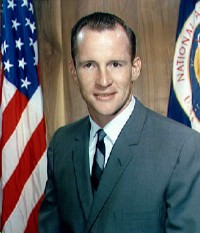
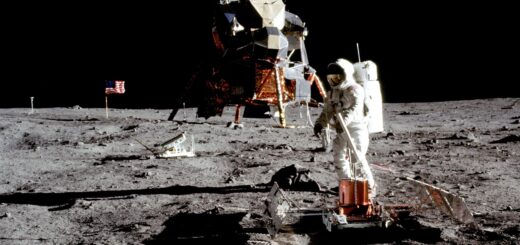
NASA Astronaut Gordon Cooper
Wikipedia https://en.wikipedia.org/wiki/Gordon_Cooper
In 1957 the United States officially launched Project Mercury, its first crewed spaceflight program. Leroy Gordon Cooper, one of the seven astronauts at the time, witnessed a UFO landing with his own eyes. He was the only astronaut then who had seen a UFO in person. In 2004, Cooper, aged 77, developed Parkinson’s disease and died of heart failure.
In 1957, while Cooper was with a special test-pilot group at Edwards Air Force Base in California, he saw a real UFO with his own eyes. Cooper said: “We were flying a mission at the time. Suddenly a glowing saucer came into view and kept circling. After a few minutes, three legs extended from the bottom of the UFO as landing gear, and it slowly landed on the dry lake bed. Because my aircraft carried a professional camera, the footage of the UFO was of very high quality.

It was clearly an alien spacecraft. When we tried to approach the area around the lake, it took off.” According to Cooper, after he filmed the UFO he sent the film to Washington and reported the encounter to NASA. For decades afterward, NASA said nothing about it. According to Cooper: “I took the photos to NASA, and after a while a senior officer told me the matter had to stay secret.” Cooper was convinced that the alien who crashed at Roswell, New Mexico, in 1947 was the same alien he had filmed piloting the UFO, and he also believed the U.S. government had recovered alien remains from that crash.
Cooper added: “I had a good friend who had been an officer at Roswell. He once let me in on a hint of what happened, and he made it clear to me that what crashed was an alien spacecraft and that the crew had all been recovered. That was all my friend could say. But I can’t keep this to myself any longer, because I believe the people of this planet have a right to know that advanced civilizations really do exist elsewhere in the universe.” Cooper said: “It began in the Second World War, when the government did not want the public to learn anything about UFOs, for fear they would panic. Ordinary people would worry that we could not defend ourselves against alien technology. During the Cold War, for the same reason, it got worse. So NASA lied to the public. NASA did not want the matter to spread.” Cooper said: “Now I am sure that many embarrassed government officials are sitting in their offices trying to find a way to cover up the truth. They know the truth will come to the surface one day.”
Biography
As is well known, Leroy Gordon Cooper Jr. (Gordon Cooper Jr.) was a colonel in the U.S. Air Force, one of America’s original seven astronauts, the astronaut of the “Faith 7” (Faith 7) spacecraft, and commander of Gemini 5.
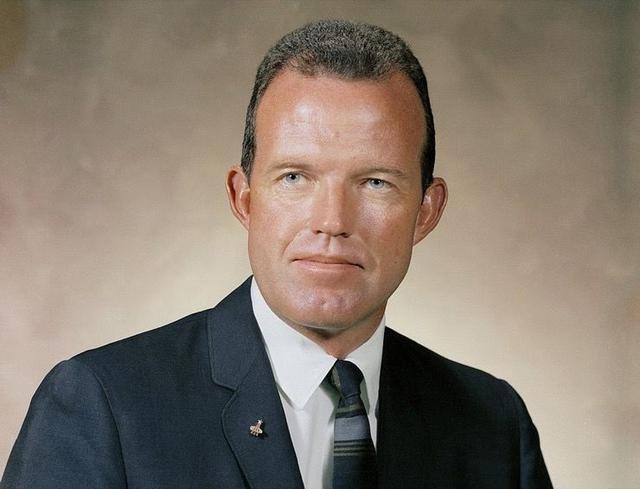
Gordon Cooper was born on March 6, 1927, in Shawnee, Oklahoma. His father, Leroy Gordon Cooper Sr., was a U.S. Navy veteran of the First World War and had served on the presidential yacht Mayflower. His mother, Hattie Lee, was a teacher. After the First World War, Cooper Sr. went back to finish high school, and Hattie Lee was his teacher. He then joined the Oklahoma National Guard and flew the Curtiss JN-4 monoplane. After finishing college and law school, Cooper Sr. became a state district judge. During the Second World War he returned to active duty and served with the judge advocate section in the Pacific theater. In 1947 he transferred to the U.S. Air Force, served at Hickam Air Force Base in Hawaii, and retired in 1957 as a colonel.
At Shawnee High School, Gordon Cooper Jr. was on the football and track teams, and in his senior year he played halfback in the state football championship. After joining the Boy Scouts of America, he earned Life rank, the second-highest rank. Because his parents owned a Command-Aire monoplane, Cooper Jr. learned to fly very young. He made an informal solo flight at 12, and at 16 he earned his pilot’s license in a Piper J-3 Cub light biplane. After his father returned to active duty, the family moved to Murray, Kentucky, and Cooper Jr. graduated from Murray High School in June 1945.
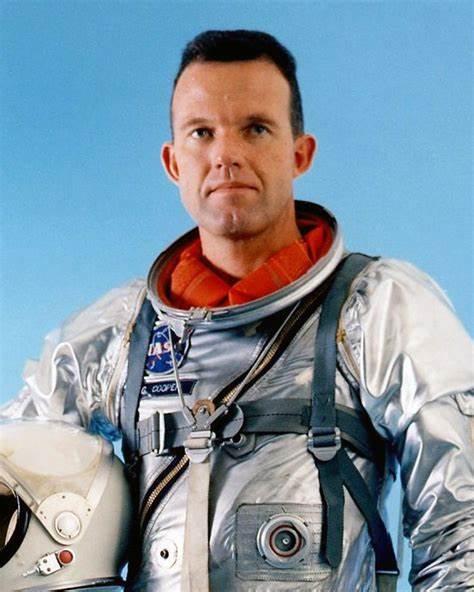
After learning that the Army and Navy flight schools were no longer taking students, Cooper joined the Marine Corps. He went to Parris Island right after high school, but the Second World War ended before he could be sent overseas. Cooper was enrolled in the U.S. Naval Academy Preparatory School, but in 1946 he was discharged from the Marine Corps and assigned to the presidential guard in Washington.
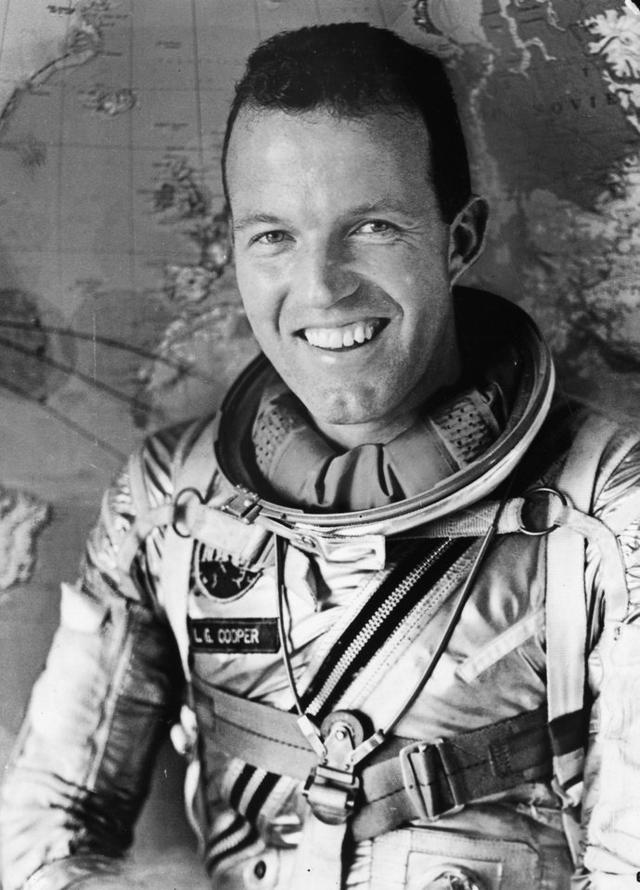
Cooper then went to Hawaii to live with his parents, entered the University of Hawaii, and bought his own J-3 Cub. At a local flying club he met his first wife, Trudy B. Olson, who was an active pilot at the time and later became the only Mercury astronaut’s wife to hold a pilot’s license. They married in 1947 and had two daughters, Camala Keoki and Janita Lee.
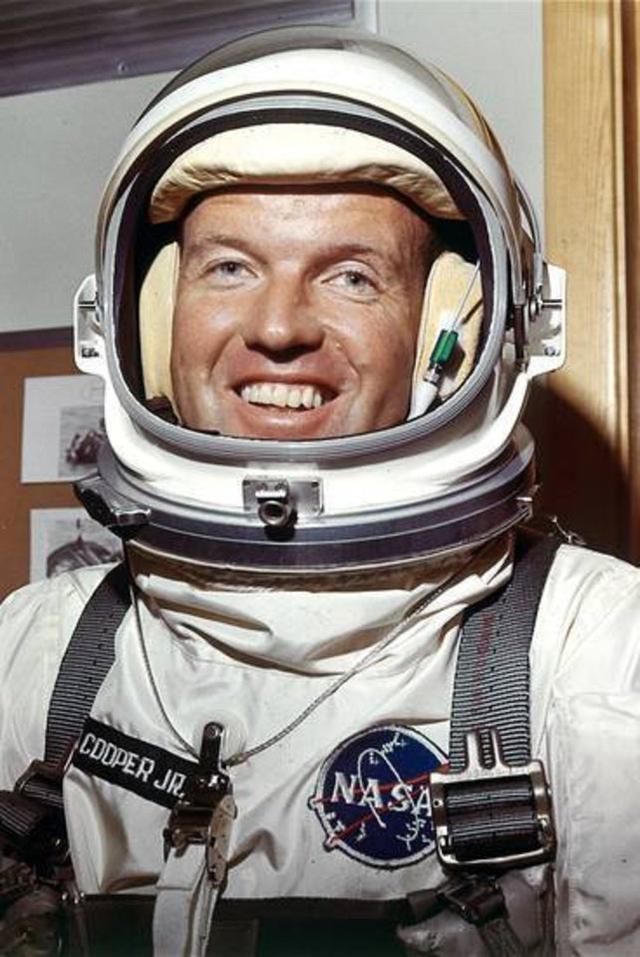
In college Cooper joined the Reserve Officers’ Training Corps. In June 1949 he was commissioned a second lieutenant in the Army, and in September 1949 he transferred to the U.S. Air Force. He took T-6 Texan flight training at Perrin Air Force Base in Texas and Williams Air Force Base in Arizona.
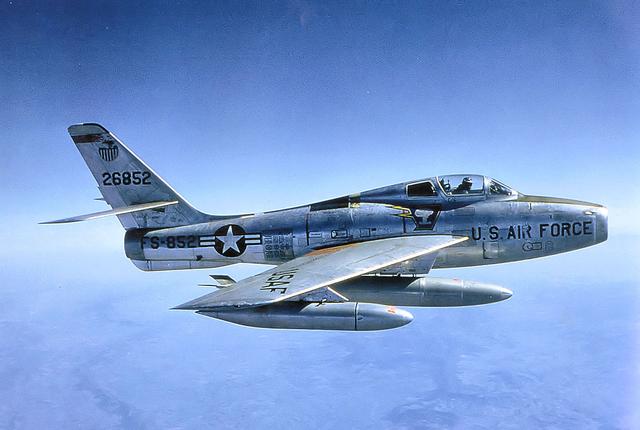
In 1950 Cooper finished flight training and was posted to Landstuhl Air Base in West Germany, flying F-84 and F-86 fighters. Four years later he became flight commander of the 525th Fighter-Bomber Squadron. While in Germany he studied at the University of Maryland’s European Division. He returned to the United States in 1954, continued at the Air Force Institute of Technology (AFIT), and in August 1956 received a Bachelor of Science in aerospace engineering.
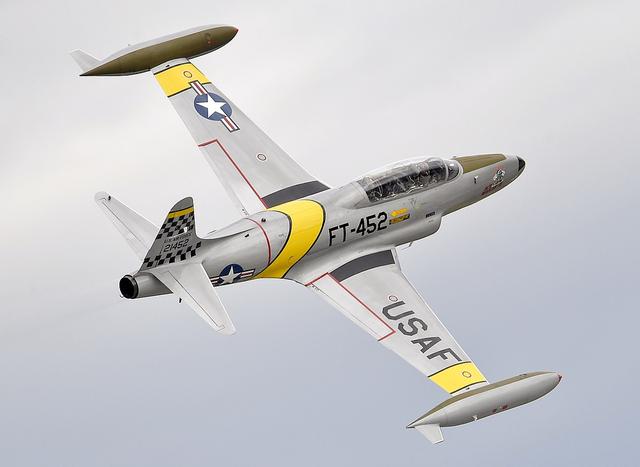
At the Air Force Institute of Technology, Cooper and his friend Gus Grissom crashed while flying a T-33 trainer. The aircraft lost power. Cooper had not taken off, but the landing gear was already up. The plane skidded 610 meters and burned at the end of the runway, but Cooper and Gus escaped.
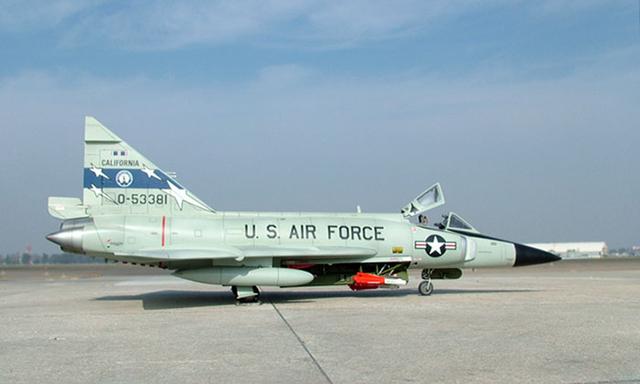
F-102A
In 1956 Cooper and Gus Grissom entered the U.S. Air Force Test Pilot School. After graduating they worked in the Flight Test Engineering Division at Edwards Air Force Base as test pilots and project test officers on the F-102A and F-106B fighters. Cooper later also flew the T-28, T-37, F-86, F-100, and F-104, among other types, with more than 2,000 flight hours, 1,600 of them in jets.
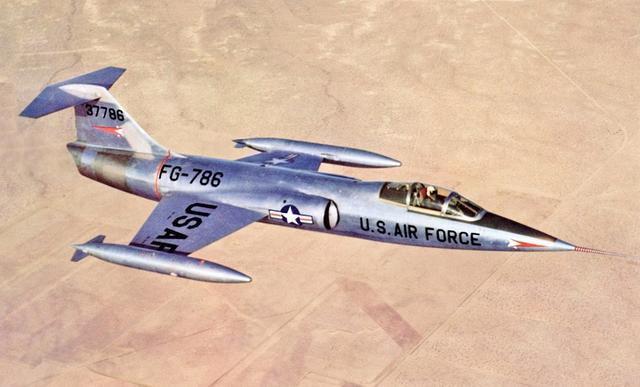
F-104
In January 1959 Cooper was ordered to report to Washington and serve under Marcus Cooper (no relation). At the time the United States had contracted with the McDonnell Aircraft Company to build a spacecraft. In February Cooper joined NASA and began astronaut training for Project Mercury. He passed a selection of 110 candidates and became the youngest of America’s original seven astronauts. When Deke Slayton heard that Cooper had been chosen, he was very surprised: “When I heard Cooper’s name, my first reaction was that there had been a mistake. He was an engineer at Edwards, and I didn’t even think he was a test pilot.”